Home › Concrete Slab Foundations and Flatwork
Superior Concrete Cleveland pours concrete slabs for homes, garages, sheds, and patios with careful site prep and reinforcement. Our team handles grading, forms, vapor barriers, and finishing so your concrete slab is flat, strong, and ready for framing or use. Trust our concrete flatwork experts to create a stable foundation for your next project in Cleveland, OH.
Superior Concrete Cleveland provides professional concrete slab throughout Cleveland, OH, Ohio and the surrounding area. Our licensed, insured crew delivers safe, clean, on-time work with a free estimate before anything begins. Call (216) 677-5617 or request your free quote.
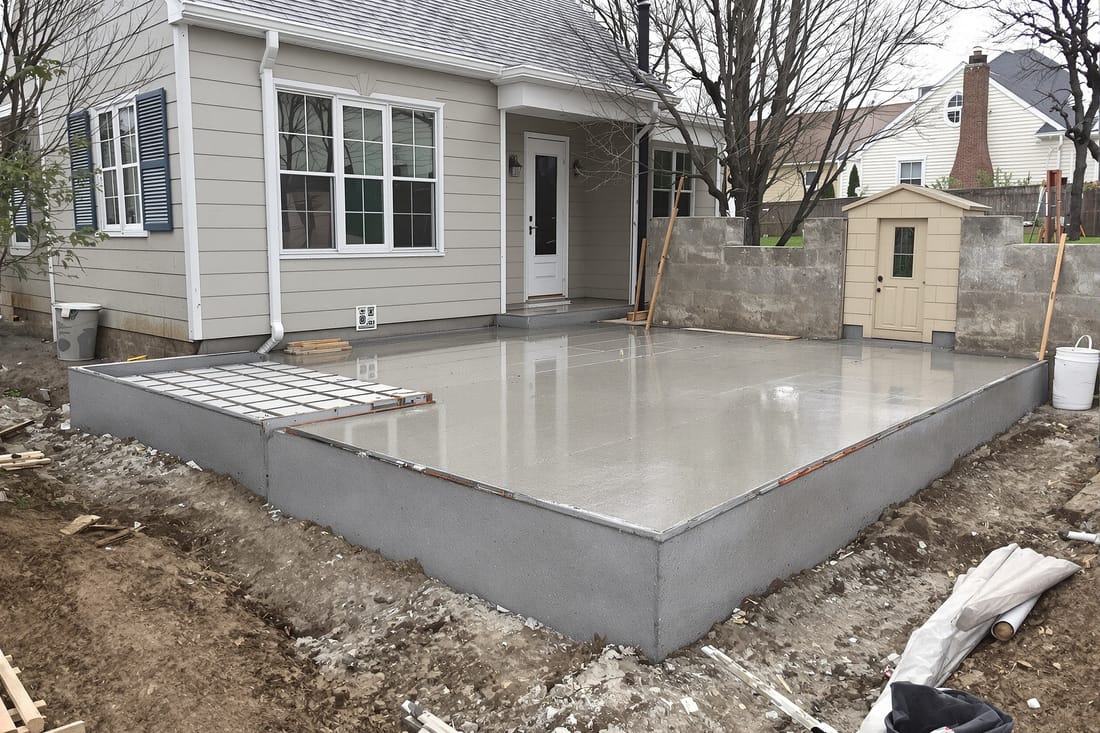
Concrete slab foundations and flatwork for Cleveland properties
If you are planning a garage, room addition, pole barn, or a new house in the Cleveland area, the concrete slab under it is what keeps everything straight and stable. Superior Concrete Cleveland focuses on designing and building slab foundations and flatwork that hold up to our freeze-thaw cycles, lake-effect moisture, and clay-heavy soils.
A concrete slab is more than a flat surface. It has to be the right thickness, with the right base stone, proper joints, and reinforcement, or you end up with cracking, heaving, and doors that stop closing right. We walk each property in person, check elevations, drainage patterns, and soil conditions, then match the slab design to what will sit on it and how it will be used.
For residential work in Cleveland, that usually means thickened edges for foundations, properly sloped flatwork for drainage, and attention to where water from your roof and neighbors actually goes. Our crews pour slabs for homes, garages, sheds, pole barns, patios, walkways, and interior floors, so we know how to adjust the mix and reinforcement based on whether the slab will carry vehicles, machinery, or just foot traffic.
How we build a durable concrete slab in Cleveland, step by step
Concrete slab foundations and flatwork succeed or fail mostly in the prep work. We start by marking out the footprint, then excavating to the depth needed for the slab and base stone. In most of Cuyahoga County, we plan for a compacted gravel base of 4 to 8 inches for garages and foundations, sometimes more if we find soft or organic soils. We remove topsoil and any buried debris, which are common in older Cleveland lots.
Next, we install formwork using straight lumber or steel forms and set the finished height with a builder’s level. At this stage we also set anchor bolt locations if we are tying in a framed structure. The subgrade and stone base are compacted in lifts using plate compactors or rollers, and we check it with a probe to confirm it is firm enough to support the slab without settling.
Reinforcement comes next. For most slab foundations and vehicle slabs, we use a combination of rebar around perimeters and at thickened footings, plus welded wire mesh or fiber-reinforced concrete in the field. In areas where driveways meet garage slabs or where there is a transition between old and new concrete, we drill and pin rebar into the existing slab so movement is controlled.
We then order a concrete mix that fits the use and season. In Cleveland, 4,000 psi mixes are common for slabs that see vehicles, with air entrainment to handle freeze-thaw. During hotter months we might use set retarders and add water reducer instead of extra water so we do not weaken the slab. For late fall pours, we bring curing blankets and sometimes use accelerators, and we adjust scheduling to avoid placing slabs when an overnight hard freeze is predicted.
Once the concrete arrives, our crew places it quickly, vibrates around rebar and edges where needed, and strikes it off with screeds or laser-guided tools on larger pours. We bull float to embed aggregate and bring up paste, then wait for bleed water to evaporate before finishing. For indoor slabs we may go to a steel trowel finish. For outdoor flatwork we usually use a broom finish for traction, then edge and cut control joints to a proper depth to manage cracking.
Local code, permitting, and inspection details for Cleveland, OH
Concrete slab foundations and flatwork in Cleveland and most surrounding cities are not just a matter of pouring and walking away. Many projects require permits and inspections, especially if the slab supports a habitable space, attached garage, or any structure with utilities. Superior Concrete Cleveland regularly works with the City of Cleveland Building & Housing Department and nearby municipalities like Lakewood, Parma, and Euclid, so we know which projects trigger plan review.
For foundation slabs, the city usually wants a foundation plan showing slab thickness, footing details, reinforcement, and vapor barrier if required. Many Cleveland-area jurisdictions look for a 42 inch frost depth on structural elements, so if we are doing a monolithic slab with thickened edges, we coordinate with your designer or engineer to confirm compliance. Some detached garages and sheds can be built on a floating slab if they stay under a size threshold, but that varies by municipality and zoning district.
Inspections are generally scheduled at key stages: after excavation and base preparation, before we pour the slab, then sometimes a final check once framing is underway. We make sure the inspector can see compaction, base thickness, rebar placement, and any required vapor barriers or insulation around slabs that are part of a conditioned space. For flatwork like driveways and sidewalks that connect to the city walk or curb, many cities around Cleveland have standards for thickness, concrete strength, and even joint spacing.
If you are in a subdivision with an HOA, there may be rules for driveway width, color, or where you can place patios and walkways. We review any HOA guidelines you have, then lay out the slab so it matches both the rules and practical water drainage. Handling these details upfront avoids failed inspections, re-work, and delays.
Cost factors and options for concrete slab foundations and flatwork
The cost of a concrete slab in Cleveland depends on more than just square footage. Superior Concrete Cleveland walks customers through every factor that affects pricing so you can make clear decisions. The first driver is use. A heated house slab with a vapor barrier, thicker sections under bearing walls, and provisions for plumbing will cost more per square foot than a basic shed slab or a broom-finished patio.
Soil conditions are next. Many older Cleveland neighborhoods have fill dirt, cinders, or buried rubble, especially behind garages and where old structures were removed. If we uncover soft spots or organic material, we either over-excavate and replace it with compacted stone or use geotextile fabric to stabilize the base. That added prep increases cost but prevents future slab settlement, which is far more expensive to correct later.
Thickness and reinforcement have a direct impact. For most garage slabs and driveways we recommend at least 4 inches of concrete, often 5 inches where trucks or equipment are stored. Structural slabs or those supporting heavy point loads, like posts for steel columns, may need thicker pads and heavier rebar cages. We explain when fiber reinforcement alone is not enough and where rebar grids really pay off.
Finish and features also affect price. A basic broom finish is most economical and works well for most outdoor flatwork. If you want a hard-troweled interior floor ready for epoxy or tile, or you want decorative saw cutting, colored concrete, or integral borders, we include those as options with separate line items. In some cases, adding a simple vapor barrier and better curing method costs little but significantly improves long-term performance.
Season and access round out the pricing. Winter work in Cleveland can require heated enclosures, curing blankets, and more crew hours to protect the slab. Tight backyards that require wheelbarrowing concrete or using a line pump add time and equipment. We put all of this in a written proposal with unit prices where practical so you know exactly what drives the total.
Common slab problems in Northeast Ohio and how we prevent them
If you have walked around Cleveland neighborhoods, you have seen what happens when slab foundations and flatwork are not built for local conditions: cracked garage floors, heaved sidewalks, and slabs that tilt toward the house instead of away from it. Superior Concrete Cleveland builds with those real-world failures in mind so we do not repeat them on your project.
Freeze-thaw damage is one of the biggest issues. Water works into the surface or underneath the slab, then expands when it freezes. To combat this, we use air-entrained mixes for exterior concrete and make sure the subgrade drains. Wherever practical, we slope slabs away from structures and tie in downspout extensions so roof runoff does not sit at the slab edge.
Random cracking is another complaint. All concrete cracks, but it should crack where we plan for it. We cut control joints at the right spacing and depth for the slab thickness, usually within 6 to 12 hours of the pour depending on weather. Around re-entrant corners, like where a garage door opening meets a side wall, we add extra reinforcement or adjust joint layout to keep cracks from shooting off at odd angles.
Scaling and spalling, especially after winter de-icing salts, show up often on driveways and front walks. We address this by following ACI curing guidelines, keeping water content under control, and discouraging the use of harsh de-icers on new slabs in their first winter. For clients who want extra surface durability, we can apply penetrating sealers after proper cure time.
Finally, poor curing ruins many otherwise well-poured slabs. We use curing compounds, plastic sheeting, or wet curing methods depending on the type of slab and finish. For large foundations, we plan saw cutting and curing steps before the pour so there is no guesswork. These measures add a small amount of time but are critical for long-term strength and appearance.